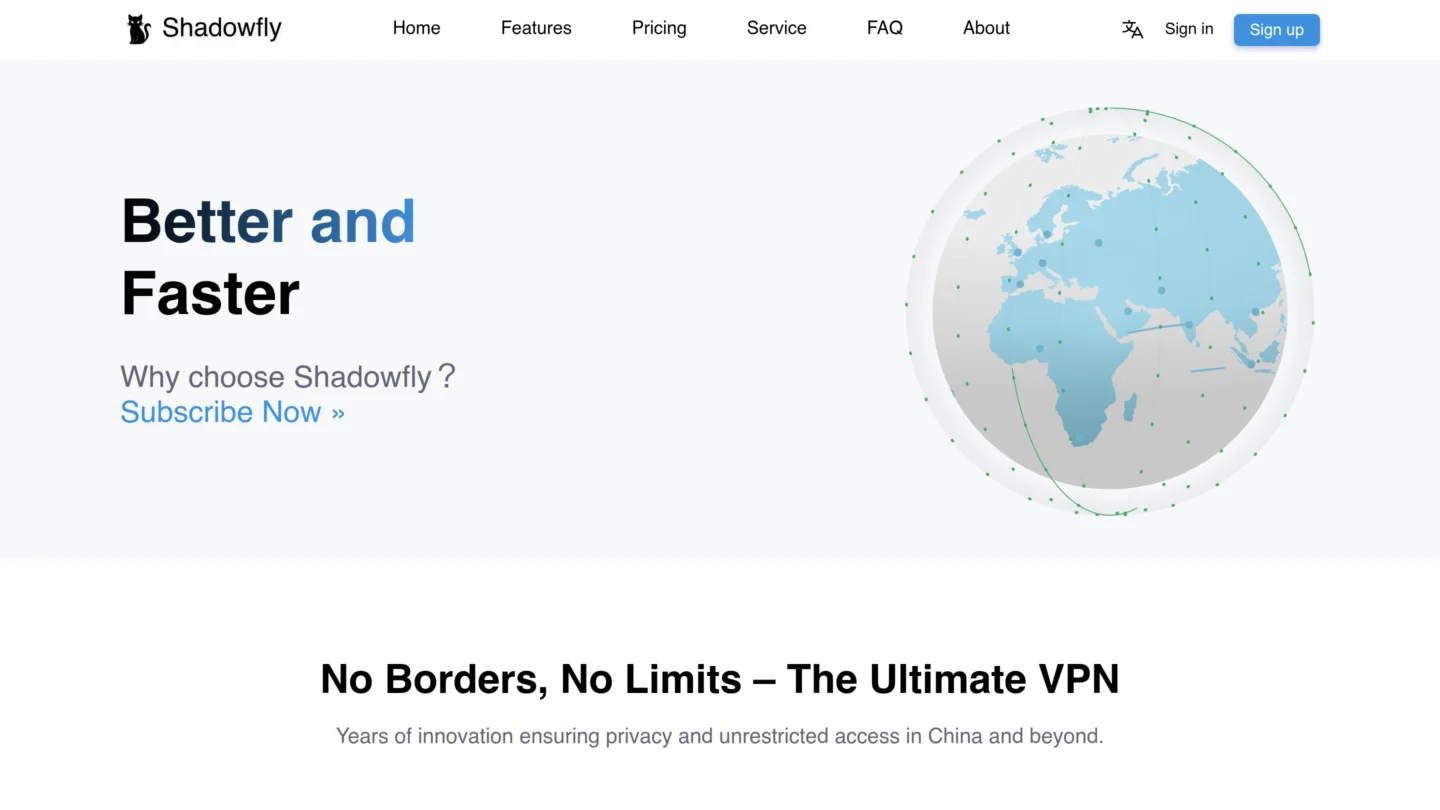
Short answer: Shadowfly is a paid proxy-style service that one China travel guide recommends. Its own site, shadowfly.org, lists four plans, a “VLESS protocol with optimized routing” and a “no logs” claim. The home page names no company, address or jurisdiction, and neither it nor the pricing page gives a refund policy, free trial or server locations. Its About page says only that the team is headquartered in Germany. We found no independent audit. We did not test the service. Do not use it for anything sensitive unless you can find out who runs it.
This is a review of what can be checked from public pages, not of how the service performs. Information was gathered on October 5, 2026 and updated on November 13, 2026 with the site’s About, pricing, privacy and terms pages. If Shadowfly has published more since then, the site is the place to look.
Table of Contents
What Shadowfly publishes about itself

The plans on shadowfly.org differ in data allowance, speed cap and device count. The prices are shown with a ¥ symbol and the page does not state which currency that is, so the figures below are copied as shown rather than converted.
| Plan | Data and speed | Devices | Monthly | Yearly |
|---|---|---|---|---|
| Essential Explorer | 50 GB, 25 Mbps | 1 | ¥9.99 | ¥101.90 |
| Streaming Starter | 150 GB, 50 Mbps | 3 | ¥14.99 | ¥152.90 |
| Power Surfer | 500 GB, unlimited speed | 5 | ¥34.99 | ¥356.90 |
| Limitless Legend | 100,000 GB, unlimited speed | Unlimited | ¥59.99 | ¥611.90 |
The site also lists quarterly and half-year prices, says the service uses the “VLESS protocol with optimized routing,” and names these platforms: Android, iOS, macOS, Windows, Linux and routers. Its headline claim is “No limits, no logs, no censorship.”
Everything the Shadowfly VPN site says about itself is marketing copy until an independent source confirms it. Shadowfly VPN sells paid plans, and what Shadowfly VPN leaves out, such as a named company, a jurisdiction and a refund policy, matters as much as what it publishes. We treat any Shadowfly VPN claim as unverified unless a third party backs it.
What the Shadowfly VPN site does not say
On the page we read, Shadowfly does not state:
- a company name or street address (its About page says only that the team is headquartered in Germany)
- a refund policy
- whether there is a free trial
- where its servers are
Those are the details that let you judge who would hold your connection data and what you could do if something went wrong. Their absence does not prove bad faith, but it is a reason to be careful.
What third parties say, and where it does not match
A China travel guide on chinaready.org describes Shadowfly as built on the Shadowsocks protocol, reliable for China and a bit more technical to set up than Astrill. The same page says its picks are not affiliate picks, but it gives no prices, company details, audits or test method for Shadowfly beyond citing user reports.
That description does not line up with the official site, which names VLESS rather than Shadowsocks. They are different protocols. Either the guide is out of date, the service offers more than one, or one of the two is wrong. We cannot tell which.
Why a no-logs claim is not enough
Almost every VPN and proxy service says it keeps no logs. The claim only means something when you can tell who is making it and when someone independent has checked it. For Shadowfly we found neither: no named operator on the page we read, and no public audit from a recognized firm. For comparison, our Proton VPN review and best VPN comparison show what published audits and named companies look like.
China, legality and practical risk

The only recommendation we found for Shadowfly is for use behind the Great Firewall. Whether and how VPN use is allowed there is a legal question, and tools get blocked without notice. Our guide to Proton VPN in China covers the legal situation and how to prepare, and stealth VPN explained covers how obfuscation works and where it falls short.
What to check before paying any unaudited service
Look for a named company and a registered address, a written refund policy, a privacy policy that says what is kept and for how long, and a payment method you can dispute if the service disappears. Start with the shortest plan rather than the yearly one. If none of that is available, treat the service as disposable and do not use it for banking, work accounts or anything else you cannot afford to expose.
What we did not do
We did not buy a plan, install the app, measure speed or test whether it unblocks anything. We also did not contact Shadowfly. This page will be updated if the operator publishes company details or an independent audit.
What the other pages on the site show
On November 13, 2026 we read more of shadowfly.org than in our first pass. The home page links only to the pricing, login and register pages, so we tried the privacy, terms, FAQ, about and agreement addresses directly. Here is what each gave.
- About page. It says the service is “headquartered in Germany” and run by a team of computer scientists and network engineers. That is the only statement of location we found. It gives no company name, registered address or named person, so there is still no one to hold accountable by name.
- Pricing page. Prices are shown in yuan (¥) and match the table above. The page has no refund terms, payment methods, server locations or support contact.
- Privacy and terms pages. Both load, but the text we could read says to enable JavaScript to read the full policy, or to contact support through a ticket after signing in. We could not read what is logged, how long it is kept or what the refund terms are. The FAQ and a second terms address returned a page with nothing on it.
- Home page. Besides the claims quoted above, it mentions “premium IPLC dedicated lines” and says strong encryption protects your privacy on public Wi-Fi. These are marketing statements with no named test or audit behind them.
A privacy policy that sits behind a login is a practical problem. You cannot read what you are agreeing to before you pay, and a policy you cannot read cannot be compared with the “no logs” line on the front page.
What VLESS does and does not do for Shadowfly VPN
The Xray project, which develops VLESS, describes it on its own documentation site as a stateless, lightweight transport protocol that links Xray clients and servers. Its documentation also says VLESS removes redundant encryption, and that the encryption setting in the protocol accepts only “none”. That page is undated, so it may have changed. Put plainly, VLESS by itself is not what encrypts your traffic.
Encryption and disguise come from other layers that a service can wrap around it, such as TLS or the project’s REALITY feature. Shadowfly’s pages say it uses VLESS and that its encryption is strong, but we could not find which layer it uses, so we cannot say how your traffic is protected between your device and its server.
This also bears on the earlier mismatch between the official site and the China guide. Shadowsocks and VLESS are separate protocols with separate designs, and a service that supports both would normally say so on its own pages. Ours does not.
A Shadowfly VPN review can only report what the service publishes and what third parties say about it. The Shadowfly VPN site sells paid plans but gives no company, jurisdiction or refund policy that we could find, so the sensible reading is caution: check the open questions above before you pay.
Frequently asked questions
Is Shadowfly legit?
We cannot confirm that either way. We found no named operator and no audit, which is a reason for caution, not proof of bad faith.
Does Shadowfly use Shadowsocks or VLESS?
Its own site says VLESS. A third-party guide says Shadowsocks. We could not reconcile the two.
Is Shadowfly safe to use in China?
We have no evidence on its reliability or safety there. The only China-specific claim we found is in a third-party guide that does not publish its test method.
Is there an audited alternative?
Providers with published audits exist, and our comparison lists them with the sources behind each claim. Whether they work in China at a given moment is a separate question.
Does Shadowfly say where it is based?
Its About page says the team is headquartered in Germany. It gives no company name or address, and the pages we could read do not say which legal entity operates the service.
Can I read Shadowfly’s privacy policy?
On November 13, 2026 the policy page told us to enable JavaScript or contact support after signing in, and we could not read the text. We therefore cannot say what the service logs or keeps.
Does VLESS encrypt my traffic?
The Xray project’s documentation describes VLESS as a lightweight transport protocol and says its own encryption setting accepts only “none”. Encryption comes from other layers around it. Shadowfly does not say which layer it uses.
Is Shadowfly VPN safe to pay for?
We could not verify the company, jurisdiction or refund policy behind it, so the cautious answer is to check those first and not to pay for anything you cannot verify.